
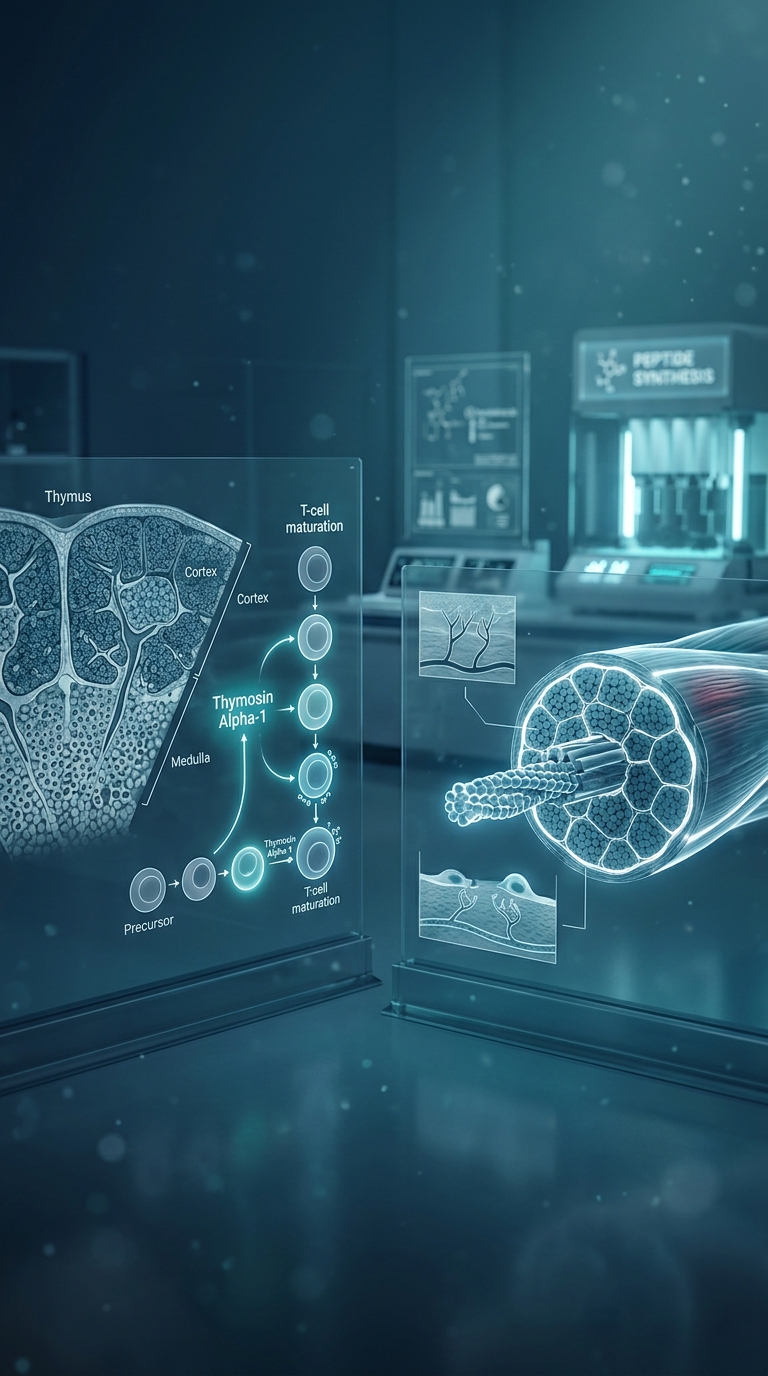
Thymosin Alpha-1 vs Thymosin Beta-4: Immune Modulation vs Tissue Repair in Research
TL;DR. Despite sharing the "thymosin" prefix, Thymosin Alpha-1 (Talpha1) and Thymosin Beta-4 (Tbeta4) are structurally and functionally unrelated peptides. Talpha1 is a 28-residue immunomodulatory peptide clinically approved in 35+ countries for viral and immune-deficient indications. Tbeta4 is a 43-residue actin-sequestering peptide used extensively in tissue repair, angiogenesis, and dermal-regeneration research. Confusing one for the other is a common institutional-buyer error.
Side-by-side
| Feature | Thymosin Alpha-1 | Thymosin Beta-4 |
|---|---|---|
| Residue count | 28 | 43 |
| Molecular weight | 3108 Da | 4963 Da |
| Family | Alpha-thymosin | Beta-thymosin (actin-binding) |
| Discovered | 1977 (Goldstein) | 1981 (Low, Goldstein) |
| Primary mechanism | Toll-like receptor (TLR9) agonism, T-cell maturation | Actin monomer sequestration, G-actin binding |
| Research domain | Viral immunity, immune reconstitution | Wound healing, cardiac remodelling, angiogenesis |
| Clinical approval | Yes (35+ countries, chronic hepatitis B/C) | Investigational only |
| Commercial name | Zadaxin (SciClone) | TB-500 (research only) |
| Natural source | Thymus gland | Ubiquitous (highest in platelets, saliva) |
Thymosin Alpha-1 signals through TLR9 on dendritic cells, upregulating Th1 cytokine production and T-cell maturation. Thymosin Beta-4 binds G-actin at a 1:1 ratio and acts as the principal actin sequestering peptide in mammalian cells. The two have no shared receptor, no shared signalling pathway, and no shared research application.
Research applications
Thymosin Alpha-1
- Chronic viral infection models (HBV, HCV, HSV)
- Vaccine adjuvant studies (particularly influenza, hepatitis)
- Sepsis immune-reconstitution research
- Immunosenescence and age-related T-cell decline models
Thymosin Beta-4
- Dermal wound closure and scar reduction research
- Corneal re-epithelialisation studies
- Myocardial infarction post-ischaemic repair models
- Angiogenesis assays (HUVEC tube formation)
- Hair follicle stem cell activation research
Why they get confused
The naming convention from 1980s biochemistry (Thymosin Fraction 5 separated into alpha and beta components) is the source. In 2026 they are known to be unrelated at the gene level: Talpha1 is cleaved from Prothymosin alpha (PTMA on chromosome 2); Tbeta4 is encoded by TMSB4X on the X chromosome. The shared prefix is historical only.
Institutional buyers requesting a quote for "thymosin" without specifying alpha or beta receive the wrong peptide approximately 1 time in 20, according to internal error-tracking from major research-grade suppliers.
Reconstitution and storage
Both are supplied as lyophilised white powder.
- Thymosin Alpha-1 (1.6 mg or 5 mg vial): 1 mL bacteriostatic water yields 1.6-5 mg/mL. Stable 30 days at 2-8 degC reconstituted; 24 months at -20 degC lyophilised.
- Thymosin Beta-4 (5 mg vial): 1-2 mL bacteriostatic water yields 2.5-5 mg/mL. Same stability window.
Both are highly stable in lyophilised form but should be reconstituted immediately before an experimental window given the 30-day limit at refrigerator temperature.
CoA requirements
For both peptides, institutional procurement should insist on:
- HPLC purity greater than or equal to 98.5% for Talpha1, greater than or equal to 97.0% for Tbeta4 (the longer sequence has tighter synthesis limits)
- MS identity confirmation (observed vs theoretical monoisotopic mass)
- Karl-Fischer water content less than 8%
- HPIEC acetate 6-12%
- LAL endotoxin less than 0.25 EU/mg
- Sequence confirmation via Edman degradation or MS/MS (particularly for Tbeta4, which is often misrepresented as a shorter "TB-500" fragment, see below)
The "TB-500" labelling trap
"TB-500" is a commercial name used for Thymosin Beta-4 research powder. Some vendors ship a 17-residue active-fragment analog (sometimes called "TB4-Frag" or "LKKTETQ fragment") under the "TB-500" label. The full-length 43-residue Tbeta4 and the 17-residue fragment are not pharmacologically equivalent. Verify the MS mass on the CoA matches the 4963 Da full-length molecule.
Bulk sourcing
Both peptides are available at institutional volumes. Points to verify:
- Thymosin Alpha-1: confirm acetylation on the N-terminal residue (natural Talpha1 is N-acetylated; non-acetylated variants have different TLR9 affinity)
- Thymosin Beta-4: confirm full-length 43-residue sequence (see TB-500 trap above)
- Lead time: 48 h handling plus regional transit
Working with Penlab Peptide
Penlab supplies both Thymosin Alpha-1 (N-acetylated full-length) and full-length Thymosin Beta-4 (43 residues) in research tiers from 10 mg to 500 g per order. CoAs include MS identity, HPLC purity, KF water, HPIEC acetate, and LAL endotoxin. Visit the bulk procurement portal or email sales@penlabpeptide.com.
Products are sold strictly for in-vitro laboratory research by KYC-verified institutional buyers.
Articoli di ricerca correlati
SPPS vs Liquid-Phase vs Recombinant Peptide Synthesis: What Research Buyers Should Know
Leggi l'articolo →BPC-157 Tendon Repair Research for Australian Laboratories: Dual-Pathway Models, Reconstitution & QA Standards
Leggi l'articolo →Peptide Shelf-Life Modeling with Arrhenius Kinetics: QC Decisions for Research Storage
Leggi l'articolo →Prodotti di ricerca menzionati
Avviso Importante: Questo articolo è solo a scopo informativo ed educativo. Tutti i prodotti menzionati sono esclusivamente per la ricerca scientifica e non sono destinati al consumo umano né a uso terapeutico.